Tag Archives: Malaysia

A MATTER OF PRECISION

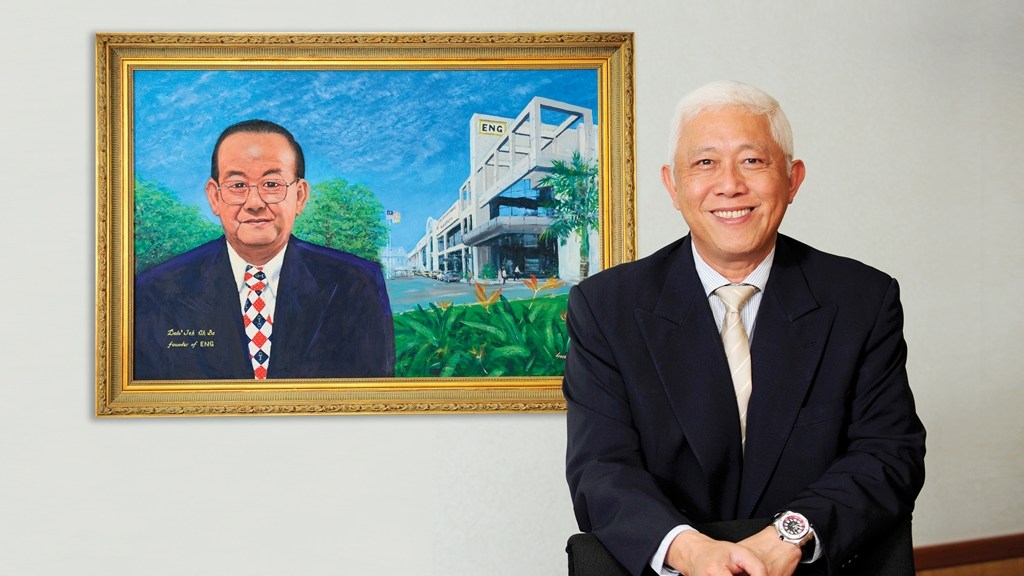
Over 30 years ago in the idyllic Penang town of Air Itam, a Chinese physician who loved to tinker with his toolbox came up with a brilliant idea. With a passion for mechanical inventions and a fascination with machinery, the late Dato’ Teh Ah Ba did the unconventional; he opened a workshop, Eng Hardware Electrical, behind his clinic in 1974. The workshop produced jigs and fixtures. Today, that workshop has grown to become of Malaysia’s leading homegrown producer of precision tooling for the semiconductor industry – the ENGTEK Group.

A journey that is as remarkable as it is inspiring; the evolution of Eng Hardware Electrical to ENGTEK Group is one of calculated precision. The late 1980’s saw the company opening a 40,000 sq ft plant in the Bayan Lepas Industrial Zone and venturing into actuator production for the hard disk drive industry. It was also during this time that ENGTEK’s investment holding company, Eng Teknologi Holdings Bhd (ETHB), was set up.

In 1993, ETHB debuted on the Bursa Malaysia Second Board. Since then, ENGTEK has set spread its reach to outside of Malaysia, setting up plants in the Philippines and Thailand, as well as forging strategic alliances with Singapore’s Altum Precision, making it the Group’s first regional acquisition. ENGTEK celebrated its 30th anniversary in 2004 and is today the leading manufacturer and supplier of electrical components in South East Asia.

Despite its rapid expansion, ENGTEK has remained a family business, run by the core members of the late Dato’ Teh’s family. At the helm of the group is Dato’ Teh Yong Khoon (YK Teh), the late Dato’ Teh’s son, who is the CEO of ENGTEK. In an interview with EZ, YK Teh said that he growing up under his father’s tutelage prepared him to lead the company in the direction that his father would have been proud of. ‘I would say that I have enjoyed the life growing up with him. I really respect him in many, many ways and he brought me up as a good technical man. It also gave me a lot of opportunity to learn together from him,’ said YK Teh.

YK Teh’s proclivity towards the engineering and mechanical field was clearly one that was in part cultivated from young and the other matched by an interest that was sparked by being exposed to his father’s business. ‘I have always been very involved in the technical aspect of the business, rather than corporate planning or anything else – it is the technical part like research into process improvement and research in new product development to fulfill the customer’s needs. It always triggers me, you know, like a really huge hobby, trying to perfect or improve a product,’ he said.

ENGTEK, which was transferred to the Main Board of Bursa Malaysia Securities Berhad in 1999, recently underwent the process of privatization. The move to privatize, said YK Teh, is one of the best decisions the Group has made thus far. ‘Having it listed, I guess we had the ego of trying to expand, and then going into listed status 20 years ago which is in 1993. We did a good job, I must say, for the last 20 years. We did not have any funds or sourcing from the listed market, so in actual fact we’ve been putting in quite of a lot of dividends public after the listing process.’

‘At the same time, the last thing that we do see here is that we are in an industry that needs a huge transformation. We do believe that we need a change and the change could be dangerous or risky for our shareholders. So we see which change is best and do it ourselves. If it’s going to be positive, we can have the company listed again in the future. If it’s negative, then we’ll shoulder all the risk. Now, will this be better for the family? I must say that it will definitely be better for the family because we are all committed for this change that we want. So long-term wise, I think it is still very good for us to go in and to take the company private, which has already been one year. We are setting the footprint on going forward into other industries which are still focused in precision engineering,’ said YK Teh.

ENGTEK’s success in not only growing to become a multinational but also to withstand the downturn in Penang’s electronic sector and thrive is remarkable. Some may even say that Penang’s electronic industry is a sunset industry. To this, YK Teh said, ‘Well if you take Penang as a sunset industry for electronic sectors, I won’t say that it is 100 percent true statement. If you look at it in terms of labour cost or the ‘Made in China’ or the greater China side of it or if you talk about Thailand, Malaysia has still been one of the best in terms of engineering and the talent supply versus others, although we cannot be like same as China, because of the huge gap between our and their labour force.’

Penang, he said, has continued to support a sizable electronic industry with some of the businesses growing bigger and some graduating from manufacturing low-cost products to developing high value products. There are electronic manufacturing services companies in Penang that manufacture components for diverse high-tech fields such as aerospace, compute  ‘They’re getting products that are much higher value, products that need a lot more talent as compared to before, and I think that you can see that there are a lot more engineers that are involved at this particular point. So, about the electronics industry actually being a sunset industry and going away, I don’t believe so,’ commented YK Teh.

For ENGTEK to have weathered the storm and expand its business beyond the borders of Malaysia, the level of commitment from the leadership of the company to the unity of the management had been strong. This must have been particularly tricky seeing that YK Teh was dealing with family members, which can be stressful. There is even a saying in this part of the world that family businesses normally cannot survive past the second or third generation, and in response to this, he shared, ‘I think it is mainly dependent on the support from other family members and their involvements, be it in terms of conflicts or not, whether are they really supportive. So if the family is supportive, then I would say that it is not hard to run the company at all.’

With ENGTEK, he said the company does hire professionals to fill certain posts seeing that the Teh family is not big enough to fill all the seats within the company. This practice, he said, is prevalent in many other Chinese family businesses in this region. ‘I don’t think they will go with the tradition where every member of the family has to come to work in the company, or the son or whomever has to be at the helmship of the CEO, or the No. 1 post,’ he added.

Being entrusted with the responsibility of continuing his father’s legacy, we asked YK Teh if being in such a position was hard. ‘No, not hard at all,’ he answered, adding that his family is very supportive of one another and him. Besides the support system provided by his family, YK Teh said that having a right balance in life and time management was key to stability. ‘You have to have the time; you got to have your own time to do activities other than work. To me, time is how you decide, how you allocate. So if you just work, I would say, even if you work 24 hours, seven days a week, it will still be the same as when you work 8-to-5, go home, enjoy life and then come back. In fact, you will be even more effective when you take a break. Activities with family and activities by yourself, I believe, there always needs to be a balance in terms of life and not work alone.’

But then again, being a CEO of a thriving group such as ENGTEK is bound to have a toll, which YK Teh agreed. ‘You are still at the higher end in terms of stress as compared to others,’ he said, ‘But that doesn’t mean that you can totally de-stress.’ De-stressing, for YK Teh involves personal time and time with family and friends. An avid golfer, he enjoys playing golf with his golfing buddies. As for family time, he is just like every other Malaysian who loves food. ‘Going on trips with my family, it’s always a good thing to do for family bonding. One of the things to like to do together is eat. Sometimes we take trips, ‘makan’ trips,’ he said, with a twinkle in his eyes.

The Malaysian Art Industry

The Asian art market is currently one of the fastest growing business markets in the world, with China, Indonesia and India leading the charge followed by emerging countries such as Vietnam, Philippines, Singapore and even Myanmar. Auction houses are consistently hammering art pieces into record prices, making it hard to believe that some still consider art as nothing but a beautiful object that one should only acquire when spare cash is available. This primitive perception has long been overturned in the West where art is not only considered an important part of a growing civilisation, but is also a lucrative and exciting investment. Art in the West do not only to adorn walls, but are also regarded as assets that are kept in the accounting books.

Malaysian contemporary art scene has been relatively slow in entering the international arena. There are artists who have been struggling throughout the years on their own, trying to make a name in the West without the backing of their motherland and it is an uphill task.

The establishment of the National Art Gallery (now known as National Visual Arts Gallery or NVAG) in 1958 by Malaysia’s first Prime Minister, Tunku Abdul Rahman, was the most important milestone in the Malaysian art history. However, as it happens in almost every other developing country, art came to be considered the ‘adopted child’ in terms of priorities. Fortunately there have been some collectors and institutions collecting Malaysian art since its early days. Bank Negara Malaysia (Central Bank of Malaysia) was one of the early institutions that, through the leadership of its second governor, Tun Ismail Ali, started collecting and supporting Malaysian art since 1962. It was indeed an important step towards recognizing art talents and helping the art industry but the influence then was very much limited.

Many art groups and art societies were formed in the name of art between the 1940s and the 1960s, but most did not survive as art was a tough profession then to be associated with. Remarkably, the oldest registered art society in Malaysia, the Penang Art Society, has not only survived, it has thrived and celebrated its 60th anniversary in 2013 and boasts a national membership of more than 400.

Furthermore, the support from senior art promoters is invaluable. One of them, Dato’ Dr Tan Chee Khuan, is probably one of the heavyweights in promoting Malaysian pioneer artists since the early 1980s. He has published more than thirty books about Malaysian art and has also donated millions worth of art works to both the national and state art galleries. A person of such vision and patriotism is a rare breed.

Other art related figures are Ooi Kok Chuen and Dr Zakaria Ali, both art writers that have been consistently contributing to local art happenings and its progress through their pens for the past twenty odd years. The setting up of Petronas Gallery in 1993 provided extra avenues in the art market, and together with NVAG, both organisations have consistently collected, exhibited and supported Malaysian contemporary art. Another important Malaysian art movement was the art residency projects by both public institutions and private organisations that provided a platform for artists to excel.

In 2008, art entrepreneur and collector Datuk Vincent Sim pulled his resources together and created another milestone in the Malaysian art industry by conceiving Malaysia’s very own international art exposition – Art Expo Malaysia. It was a move that initially many had thought off as another white elephant, but Datuk Sim and son Sim Pojinn have proved the critics wrong as the show has gone from strength to strength through years of hard work.

Another instrumental development in the Malaysian art front was the Malaysian government’s helping hand in making this art expo even more successful. The 1MCAT (1Malaysia Contemporary Art Tourism) programme that was initiated in 2010 was the brainchild of the Ministry of Tourism (now known as Ministry of Tourism and Culture) with the intention to promote contemporary Malaysian art as a tourism product catering to the tourists visiting the country.

The Ministry of International Trade and Industry, through its external promotion arm, MATRADE, also joined in providing certain tax claimable incentive for local exhibitors, making it more attractive to join in and promote Malaysian art in local and international expositions. Furthermore, it has provided special rates on the space rentals in MATRADE Exhibition & Convention Centre where the Art Expo Malaysia has been holding its expositions for the last few years.

In 2009, prominent Malaysian real estate consultancy, Henry Butcher (HB), teamed up with Vincent Sim and started the HB Art Auction. The arrival of the first proper art auction house in Malaysia was a major boost to the art industry, eliminating the taboo of Malaysian contemporary art having an almost non-existence secondary market. KL Lifestyle Art Space (KLAS) Art Auction was the second one to join the party in 2012, followed by the Indonesian-owned Masterpiece Auction and the Edge Auction in 2013, making an unprecedented yet impressive record of four auction houses conducting more than 10 auctions annually!

With positive anticipation from local art patrons and collectors, the domestic market for Malaysian contemporary art is heading for a bull run. For example, top framer Pinkguy’s gallery reported sold out exhibitions in 2013 of two artists – Suzlee Ibrahim and Ch’ng Huck Theng – less than half an hour after the exhibitions’ openings.

On the other hand, important commercial art galleries, such as Valentine Willie Fine Arts, Wei Ling Gallery, Galeri Chandan and Richard Koh Fine Art, are among the Malaysian galleries that frequent regional art exhibitions, including Hong Kong and Singapore, to further promote their resident artists. The consistency of these galleries’ participations is highly dependent on the commercial return or simply how profitable, but it nonetheless is an applaudable move.

Back in 2009, the NVAG, then led by Director General Datuk Dr Mohamed Najib and its Board, decided to seek MATRADE’s expertise to assist in promoting Malaysian contemporary art overseas. It was not an easy task as art was never considered a product of trade by the ministry. The move was necessary and important as NVAG was of the opinion that there was no proper department in the government sector designated to promote Malaysian art professionally and efficiently in the international stage.

The first meeting was held in MATRADE with Zanita Anuar and Ch’ng Huck Theng representing NVAG and Mustafa Aziz representing MATRADE Centre. As Malaysian contemporary art was at its very early stages in international recognition and without the backing of the government, it was obviously a very difficult journey to pursue. It was akin to a new Malaysian brand or product with a lot of potential trying to penetrate the international market with limited funds and experience.

The big breakthrough was in 2011 for Malaysian contemporary art when it was considered by MATRADE as a product in the soft export category. In mid-2013 MATRADE CEO Datuk Dr. Wong decided to take up the challenge and assist the Malaysian contemporary art, promoting it as a brand and product of Malaysia. This collaboration with NVAG will see Malaysian art promotions in London, Melbourne and Miami. Arts Kuala Lumpur, or Arts KL, is the brainchild of MATRADE, spearheading Malaysian contemporary art into the international business of art by providing a vital connection between local Malaysian art talents and international art players. This is a move that will eventually prosper the Malaysian art business internationally and benefit generations to come.

Discover Malaysia Art

Malaysian Art Showcases In Melbourne

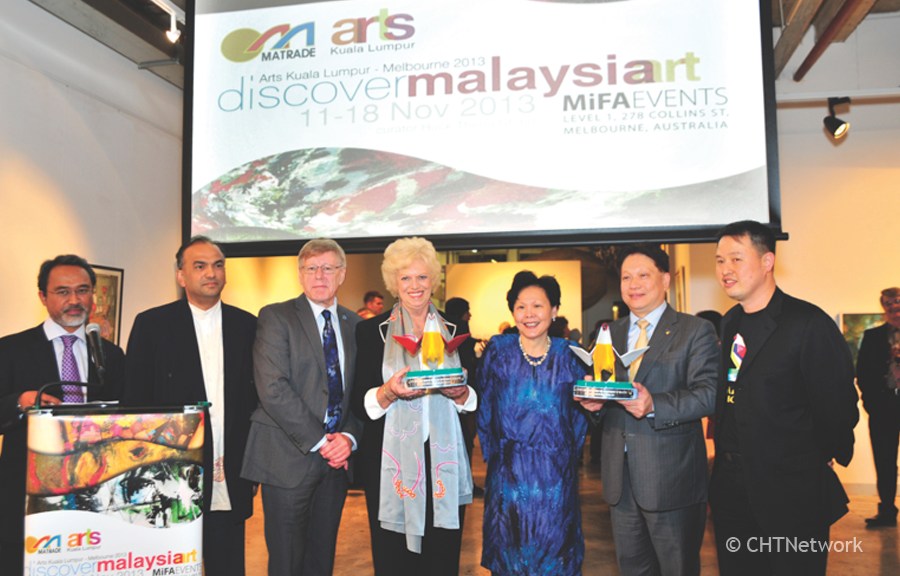
From 11 to 18 November 2013, Australian art lovers, collectors and the public had the privilege of personally getting acquainted with Malaysian art at a special exhibition titled ‘Arts Kuala Lumpur – Melbourne: Discover Malaysia Art’ that took place at the prestigious Melbourne art gallery, MiFA Events.

Datuk Dr Wong Lai Sum, CEO of Malaysia External Trade Development Corporation (MATRADE) officiated the exhibition on 14 November in a festive ceremony that served authentic Malaysian delicacies such as the satay and teh tarik.

The official opening was also attended by The Hon. Bruce Atkinson, President of the Legislative Council of Victoria; and Deputy Lord Mayor Susan Riley, Deputy Lord Mayor of the City of Melbourne. Also in attendance was the Malaysian Consul General to Victoria Dato’ Dr Mohamad Rameez Yahaya.

Wong, on behalf of the Malaysian Government, presented Riley a special Melbourne edition of Ch’ng’s ‘Salam’ sculpture as a gesture of friendship to the City of Melbourne. A second sculpture – ‘Salam – Victoria’ – was presented to National Gallery of Victoria.

The unprecedented event was the largest of its kind ever held and featured the works of 30 artists, ranging from Malaysian pioneer artists since the Independence to the young contemporary artists of modern Malaysia. Curated by Ch’ng Huck Theng, the exhibition was successful in generating great interest among art lovers in Melbourne.

Heels to Hills

EZ goes up the tranquil hills of Balik Pulau in Penang in search of one heritage gem – the Balik Pulau Lodge. A traditional Hakka settlement that is more than 200 years old, today it is a vibrant relaxation spot thanks to one enterprising and history-loving Maggie Fong.

Like the migration stories of many cultures, the story of the Hakka people in Malaysia follows in the same vein. Well before the reign of the British Empire in the Malay Peninsula, the first Hakkas to set foot on this soil arrived during the earlier part of the 18th century. It is said that they first set foot not in the East Coast of the Malay Peninsula, but on the shores of what is known to us today as Balik Pulau, on the island of Penang.

Later on, as the demand for workers in the tin mines grew, the British brought in labourers from the southern provinces of China, many of them being Hakkas. These early Hakka migrants not only brought their language – Hakka – to this new land, but also their own culture, traditions, cuisine and way of living. This wave of migrants made their wealth in tin mining, with the most famous Hakka in Malaysian history rising to prominence and developing Kuala Lumpur as Malaya’s economic and mining centre. Yes, the legendary Chinese Capitan Yap Ah Loy was a Hakka.

Today, almost a quarter of the Malaysian Chinese population is Hakka. Even in Penang, which is better known for its Hokkien community, it is home to a sizeable Hakka community. However, through the centuries, Hakkas have slowly lost their language and the culture is not as visible as the Chinese community at large has adopted Mandarin as their language. But there is an exception to the rule: among the many Hakkas living in Malaysia, is one feisty lady who has taken a bold step in the preservation of a part of the Malaysian Hakka story.

Maggie Fong, a proud Hakka, runs the Balik Pulau Lodge – a Hakka-themed homestay. Setting the Lodge apart from other ‘themed’ homestays and hotels, this place is actually a Hakka settlement that was built by migrants who came to cultivate the hillside of Balik Pulau hundreds of years ago. Right in the middle of the Lodge is what Fong calls the Hakka Big House, around which most of the activities of the homestay are centred.

Built on a rocky slope, the Hakka Big House is a testament to the resilience of the early settlers. As one enters the perimeters of the Lodge and go up the driveway, they will be met by huge boulders lined against the steep cliffs, a barricade of sorts. Not a barricade of the outside forces, but a barricade to contain the hilly slope and to prevent erosion. These acted as terraces for farming, and on which today remains a fruit orchard that produces tropical fruits in the plentiful.

‘The centuries old stone walls with 200 years of history are evidences of the Hakka ancestors who travelled here, leaving their motherland behind. They are also a reminder of how the early Hakka settlers had a hardworking and resilient spirit. Balik Pulau was undeveloped in that period and the valley was too steep, without much flat land for farming and growing crops. They worked together very hard to develop the place, and finally after years of hard work, the Hakka hill farming land was developed,’ quipped Fong.

Fong who grew up in Johor in a typical Hakka home loves to relate stories of her childhood – the stories of her people and the way they live. ‘Hakka people are very hardworking, their food is different and their home is different from the homes of other Chinese communities,’ she said, adding that the typical Hakka home is built on stilts. ‘The first generation of Hakkas lived on the hills, so, to prevent from animals entering their homes, they built their homes a few feet above the ground. So if someone knocks on their door, they could look down to see if it was their friend or enemies.’

‘After 20 years of staying in Penang, I wanted to find a place that I could do up like my kampong in Johor. So I started looking for a piece of land to build a Hakka house like the one in my hometown.’ It was in Balik Pulau that Fong found her piece of heaven. ‘I thought I can have it for my private use, and on Saturdays and Sundays, I could invite my friends to come and eat durian, to have a barbecue, to hold functions and home parties. So I bought the house and the land,’ said Fong of the 12-acre land on which the Hakka Big House stands.

She had purchased the land and the house some years ago, but it was only towards the end of October 2012 that Fong got the idea of opening the place for public. This is how the Lodge came to be established. The inspiration came to her when she went on a safari trip in Africa. Seeing the African tents and how everyone was one with nature sparked the idea to bring this concept to start the Lodge at her Hakka Big House.

‘I just wanted to retain the place’s history, to keep its heritage and to have a green place. I wanted to have a Hakka lodge on the hill, to serve Hakka food and to serve durian,’ said Fong. The Hakka Big House can house up to 30 guests. Next to it is a camp site that is fitted with 10 African-style tents and 20 mobile tents, six mosquito net hammocks, and a field camouflage yurt.

‘We have 12 acres of orchards with durian trees and cardamom trees and 40 local tropical fruits in the Hakka traditional old house. Visitors get to enjoy the cool mountain climate, the air is fresh and surrounded by greeneries, spectacular mountains and sea view,’ she said. And the Hakka Big House, it is the very same house that was lived in by the settlers, giving the visitors more than just a unique experience but also to see a slice of local history.

‘You know, we Penangites, when it come to holidays, there is nowhere to go, only shopping. I wanted a place where they can go to relax, where they can experience the fruit farm. So in October of 2012, I decided to open it to the public. After a few months of preparation, we opened to public in December 2012,’ she explained. The Lodge has been attracting numerous visitors and has been featured in many travel sites.

In the vein of her other business ventures, this one is also a resounding success. Fong, a journalism graduate who briefly flirted with the world of reporting, has always had a passion for business. ‘A business person can attain financial freedom. Even when I was a little girl, I had always wanted to be a businessman. I don’t want to be a worker – a worker has a fixed salary but not fixed expenses. But a business person has fixed expenses but not fixed income, you could have more income in one month if you wanted it,’ said Fong.

Fong is best known for the flyer distribution empire she founded with her late-husband. Flyer King was, and still is, the largest professional flyer distributor in Malaysia. While still managing the flyer distribution business  – Fong is the CEO of Flyer King – and running a stellar tourist and heritage attraction, Fong finds the time to seek adventures around the world as she backpacks to exciting locales off the beaten track. After all, the lady has kicked her heels for the hills.

Making the Fire Work

EZ has a chat with Asia’s most recognised firework maverick, Joe Ghazzal, who has orchestrated some of Malaysia’s most iconic fireworks events.

Up in the sky, breaking the treacle dark expanse, bursts of colours shoot from the ground, loud and shrill in their accent only to break out into a thunderous explosion of magical proportions. Such is the beauty of the firework, a human invention that combines the science of pyrotechnic with the aesthetics of art.

Fireworks, like many other endeavours of human expression, have over the centuries taken on various forms to produce what is known as the three cornerstone effects fireworks – the sound, the light, and most importantly, the effects.  So sophisticated are the fireworks of today that they can burn with flames and sparks of a wide range of colours and in spectacular effects with distinct sounds.

Though it may trace its roots back to 7th Century China where they were invented, fireworks have become a form of entertainment of its own.   Mind you, we are not talking about run-of-the-mill consumer fireworks that can be purchased by the public during major festival seasons but professional grade fireworks used in world class events; fireworks that have become a symbol of grandeur and prestige. These are fireworks that stretch the possibilities of pyrotechnics while continually seeking to perfect its art and science.

One such fireworks event, which also happens to be the largest international fireworks competition, is the Danang International Fireworks Competition (DIFC). Held annually in Danang, Vietnam, DIFC surprisingly has a Malaysian connection which began at its conception through the Malaysian and Hong Kong based Global2000 International Ltd. At the helm of Global2000 is the enigmatic Joe Ghazzal – a leading figure in the entertainment and events industry.

‘We were invited by the Vietnamese Government to produce the Danang International Fireworks Competition in Vietnam in 2008; we have been producing and choreographing (the competition) since then,’ said Joe. ‘DIFC is a complete success and it attracts a million visitors to watch the event over two nights.’

Prior to being invited to produce DIFC, Joe’s Global2000 was already making waves in the region for its spectacular fireworks shows and also for organizing world class events. In 2007, Global2000 organised, produced and managed Malaysia International Fireworks Competition (MIFC), which was the first ever international fireworks competition staged in Malaysia. ‘MIFC was the key and major event for Visit Malaysia Year 2007 and 50th Merdeka celebrations,’ explained Joe. ‘MIFC was hosted and supported by Ministry of Tourism in 2007 and 2008 for Visit Malaysia Year and it was a huge success that attracted 3.5 million people to Putrajaya.’

Joe’s involvement in the fireworks industry happened quite naturally. Having been involved in the entertainment industry since his university days, Joe has seen it all and conquered it all, that is, until he went full force in producing world class fireworks competitions and events. He started deejaying in Singapore during his university days and would then go on to recruiting and supplying DJs, records and equipment to new clubs, first in Singapore and then expanding up to Kuala Lumpur. ‘Whilst I was in the clubbing scene, I got into producing special events for product and brand launches in these clubs. Then I moved on and opened an event management company in 1994,’ said Joe on his venturing into event management.

‘I have done over 100 events for Petronas; I did the Launch for the Mercedes cars, produced and launched (events for) Astro, Measat, KLSE new building, KL Tower, Putrajaya, Cyberjaya, Sepang’s F1 circuit, Formula 1 opening ceremony, F1 Gala dinner and produced and managed the official Millennium celebrations at KLCC Petronas,’ said Joe. ‘I wanted to create a legacy for the new Millennium, so I produced a mega party at the Subang Terminal One, which was called ‘Zero’ – One World One Party.’ The airport, according to Joe, was a symbolic choice – it signified the departure of the old and arrival of the new Millennium. ‘It was the biggest party ever held in Malaysia that attracted more than 100,000 revellers!’

This is where the fireworks connection comes in. According to Joe, all his past major outdoor events capped off with a bang with a fireworks display. ‘As the finale was important to the event, I personally choreographed the fireworks so that the fireworks display would sync with the actual events.’

The lure of such fireworks displays is undoubtable. Elaborate fireworks displays are fascinating and quite magical. As Joe elaborated, it is ‘the creative side that is the wonder of fireworks. It is a combination of curiosity and emotion that lead us to watch these shows of explosive art. The one reason everyone continues to be fascinated with fireworks is that they remain incomprehensible. They are a chain of reactions that begins with a spark on the ground and ends in flashes of light several hundred meters in the air.’ This adds to the magical allure of the firework, which he said makes us ‘appreciate fireworks much in the same way as we do art – well-choreographed fireworks displays take us on a magical journey!’

While it may seem enchanting to the spectator, a lot of work by a large team of experts goes in to producing a wow-worthy fireworks event. ‘A major event like DIFC, requires writers, content producers, lighting designers, sound engineers, technical and safety specialists and event production team and logistics planners. To produce (the event), it takes months of planning; a team of good skilled and talented men and technical crew – which Team Global has – months of communications with clients and the selected participants,’ said Joe. On the technical front, stringent quality standards and procedures need to be adhered to.

For Global2000, which is capable to provide A to Z services for large scale international fireworks events, the gamut of its involvement in events such as DIFC and MIFC is indeed vast. ‘We implement the scheduling and format of the competitions and we also manage the press conferences, radio and television programs; receptions and other public events prior to the events,’ he said.

‘In some cases, we supply all supporting hardware and technical equipment; Mortars, Racks and firing system that is required for the fireworks competition as well as produce and manage all logistics,’ he added. ‘It’s a lot of work and many man-hours because we provide a complete turn-key production from start to end.’

The Malaysian-born-Singapore-educated Joe professed a deep passion and fascination for fireworks that goes beyond just a professional interest. ‘Fireworks have always fascinated me since I was a kid. It’s the sound of the massive explosions followed by a barrage of bright colours that makes me happy! I think it has to do with the many patterns of the fireworks because they are all different and unpredictable, just like life, and they explode in various directions and it just looks amazing above the night skies. People just love the explosions in the sky and love bright giant glowing paintings in the sky. The sky is a large canvas and fireworks allow me to paint the sky with my art.’

The sky is a large canvas and fireworks allow me to paint the sky with my art.

To Joe, everything he does seems to come from the heart. Outside his work, he is all about having a wonderful time with his family and friends. While his tastes might veer to the extravagant (a penchant for fast cars, globe-trotting and putting off at golf courses all over the world), Joe is very much grounded and humble. ‘I am a very normal fellow. I have a wonderful family just like the ordinary Malaysian Joe! I have a lovely wife and a beautiful daughter. They mean the world to me. I have a bunch of good friends and I love them too,’ said Joe. As for his work, Joe has only nice words to say, ‘I enjoy the work I do, so, it’s my hobby more than work. I put my heart and soul into my hobby.’

This hobby of his in which he has made the sky as his canvas has proven to be more than just a spectacular form of art; it has helped transform the way tourism is done. Joe and Global2000’s contribution to the region of Danang has not gone unappreciated. ‘We were presented with a special certificate awarded by the Danang Government for significant contribution to socio-economic development, international friendship promotion and humanitarian activities for the city of Danang,’ said Joe.

The God of Quality

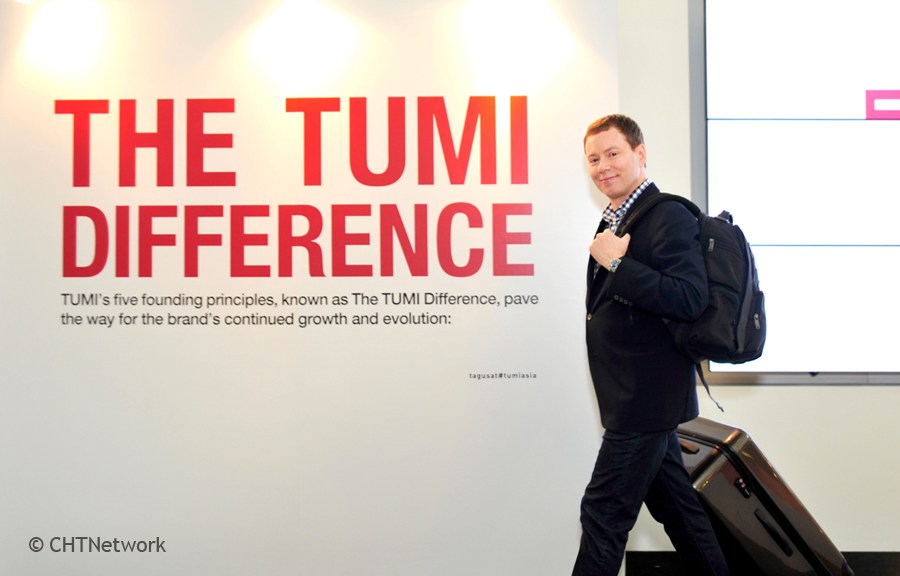
EZ caught up with Tumi Holdings, Inc’s Senior Vice President and Managing Director of Asia Pacific, Tom Nelson, when he was in Penang for the official opening of the brand’s first flagship boutique in the luxury lifestyle mall, Gurney Paragon.

In a world where the jet-setting elite are not only growing in numbers but also in sophistication and discernment, the need for excellent travel gear has generated a lucrative industry. With many brands vying for the attention of the well-heeled traveller, there is one brand that has been revolutionising the way people travel.

Taking its name from a Peruvian god, Tumi is a world-renowned brand that began almost 40 years ago, built around the basic philosophy of creating products that make people’s lives easier. The 1980s saw Tumi’s innovation – the soft, super functional, black-on-black ballistic nylon travel bags – captivate the consumers and sow the seeds for an astronomical growth. The last two decades has witnessed Tumi’s conquering of the luxury travel segment and leading the trail with its superior quality luggage, business cases, handbags, small leather goods, executive accessories, electronics, gifts, pens and watches. That the brand holds 25 patents for its design and engineering developments is no coincidence nor is being recognised as the brand with the best products in the travel and business categories.

While in the past, Malaysians could only purchase Tumi products in the brand’s flagship boutiques overseas, the last couple of years have seen a marked increase in the brand’s presence as Tumi sets up its boutiques in Malaysia. With four boutiques in Kuala Lumpur and one in Johor, Valiram Group which exclusively manages and operates Tumi in Malaysia brought the brand to Penang in October 2013. EZ caught up with Tumi Holdings, Inc’s Senior Vice President and Managing Director of Asia Pacific, Tom Nelson, when he was in Penang for the official opening of the brand’s first flagship boutique in the luxury lifestyle mall, Gurney Paragon.

As the SVP and MD of Asia Pacific, Nelson’s job covers a wide region. ‘I am responsible for the Asia Pacific region, which extends from India in the west, down to Australia and New Zealand in the South Pacific, all the way up to Northern Asia, China, Japan and then, actually, up to Hawaii. And so, that sort of is the market in the region of Asia Pacific, and I am responsible for the sales, business development, and marketing of the brand,’ explained Nelson on his role.

Nelson was seen totting a Tumi backpack, which he says has been with him for over a decade. He regards the brand and its products with great respect, something that tells us he would still be a fan of Tumi if he was not working for the company. ‘I have worked for a number of premium, high-end consumer goods brands over the course of my career, and I knew about Tumi well before I was with the company. When I was asked to meet in an interview with the company executive, I was very interested because I deeply respected Tumi,’ confessed Nelson.

‘One of the wonderful qualities about Tumi is that we appeal to clienteles we like to refer to as global citizens and these are discerning consumers who appreciate the Tumi difference and who are successful in their careers; men and women, who have a very fast-paced career who in many cases fly frequently. And so we find that the end users are truly global consumers, not just travelling but living everything. In Malaysia, just like other countries in Asia and around the world we find that Tumi began with the global citizen,’ he said, shining the light on one of the main factors that has made the brand such a success.

‘Tumi is essentially comprised of five founding characteristics and I’ll name them for you. They’re excellence in design, functional superiority, technical innovation, outstanding world-class quality and world-class customer service. Those five founding principles have always been with us within this company and this brand, and I was interested in them. On top of it, throughout my career and life, I have a passion for travel, and a portion of Tumi’s business and heritage is in travelling, so that’s very much something that appealed to me as well.’

It is the travel part of Tumi along with its continual development of good performance products that draw Nelson. Born and raised in West Virginia, US, Nelson professed to having the wanderlust even when he was a young boy. His family, he said, travelled together, often. ‘My mother in particular; she has a deep-seated love of travel, and so she would often get us out on the road,’ he related. ‘We travelled quite a bit and that’s what I think, created a thirst that I have and I still haven’t really satisfied for getting out and being in the world.’

Tumi is essentially comprised of five founding characteristics and I’ll name them for you. They’re excellence in design, functional superiority, technical innovation, outstanding world-class quality and world-class customer service.

With his job taking him around the world, Nelson has spent a wonderful 14 years with the company, which he says is quite hard to believe that it has been that long. ‘I have spent most of my 14 years either travelling to and from the US, but in the last four years I’ve actually been based in Asia, in Hong Kong,’ he answered when asked where he is based. ‘I’ve actually lived in many different places, and the great thing about that is when you live somewhere, you really get to know the city. I thought I knew Hong Kong during all the times I’ve travelled there; you really don’t know the place until you’ve lived there.’

‘But I also like to say I’m based on an airplane,’ he joked, ‘Because I’m so often on an airplane.’ Family, he said, is another reason why he travels so much. ‘I do have a family and I am married, and my family lives in the US while I live in Hong Kong so that’s one of the reasons why I travel around so much. My family shares my love of travelling as well.’

Nelson, who was flying off to a trade show the very next day, said that cities have a sort of effect on him. One of his favourite cities is Munich, Germany. ‘I love that city for its beauty and its architecture, and so I really enjoy cities that are low-hassle, that are visually beautiful, that work well and I think that sort of reflects how I like to conduct my life. My life is complicated, but I really seek to improve it.’

It would not be too far-fetched to postulate that it is with this philosophy in life that Nelson connects most with the company he works for, the brand of which he has chosen to represent. Tumi, at its core, strives to make people’s lives easier, just as how Nelson seeks to improve his complicated life. Tellingly, Nelson attributes the most rewarding aspect of his job to a very tangible experience – seeing people carry Tumi products. ‘It really is the key, the acceptance around the world of the brand and the execution of the Tumi difference. When I’m travelling around and I see other people carrying our brand, it feels very rewarding to me because it shows that we have a product that people appreciate.’

One of the very most exciting aspects of working with Tumi is also getting to work with hardworking people ‘who have such great passion for a good brand, because they recognise the authenticity of the brand’ said Nelson. According to him, Tumi is a very creative organization that is placed on the high end of entrepreneurship, making it an ideal workplace for Nelson.

‘We’re a recent public-listed company and you see the impact of your decisions straightaway. It’s not like you have to go through layers of management to see your decisions get implemented. You can make a decision today and see it implemented tomorrow. Sometimes that’s really the passion and creativity of entrepreneurship.’ Perhaps it is with these intrinsic qualities that Tumi, and its key personnels such as Nelson that have made possible for Tumi to have carved a name – a very respectable one at that – as the premier brand of high quality and luxury travel and business gear.

Artful Living For the 21st Century

For some people, luxury is a way of life rather than an occasional indulgence. Only those residences, cars, wines, watches, jewels and gadgets that live up to the highest standards of quality and style can ever win their approval. These are the people for whom EZ was created. Thanks to the magazine’s unique distribution, these are the people who read it. With a vibrant mix of luxury, fashion and people, EZ is the essential lifestyle companion to Malaysia’s ultra-discerning society.

Published quarterly, EZ can be found for your reading pleasure at the following establishments:

  • major hotels and hospitals
  • selected upmarket boutiques and prominent art galleries
  • food outlets such as restaurants and cafes
  • major bookstores such as Borders, Popular, and MPH
  • selected local and international airports