
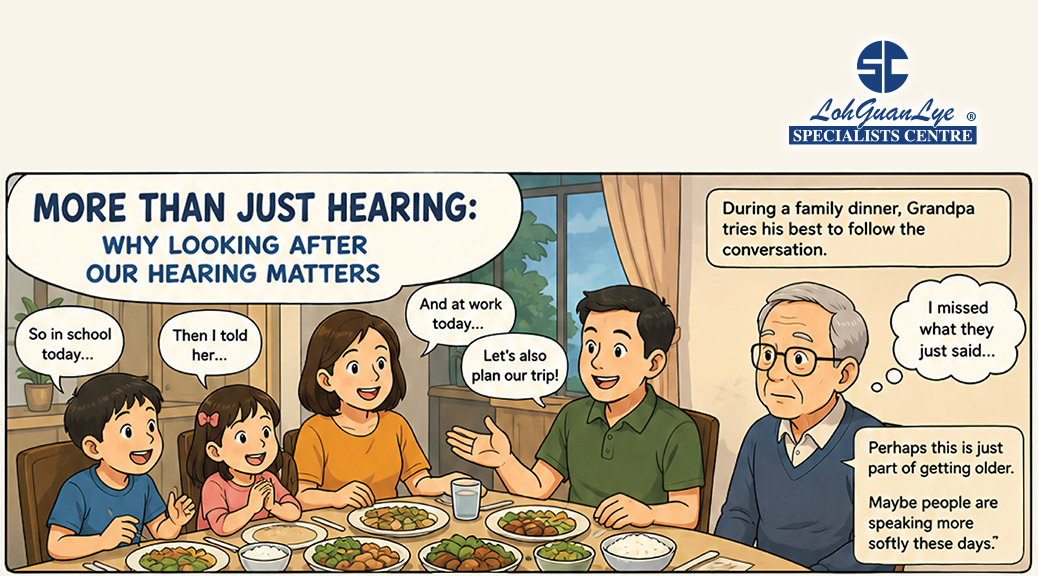
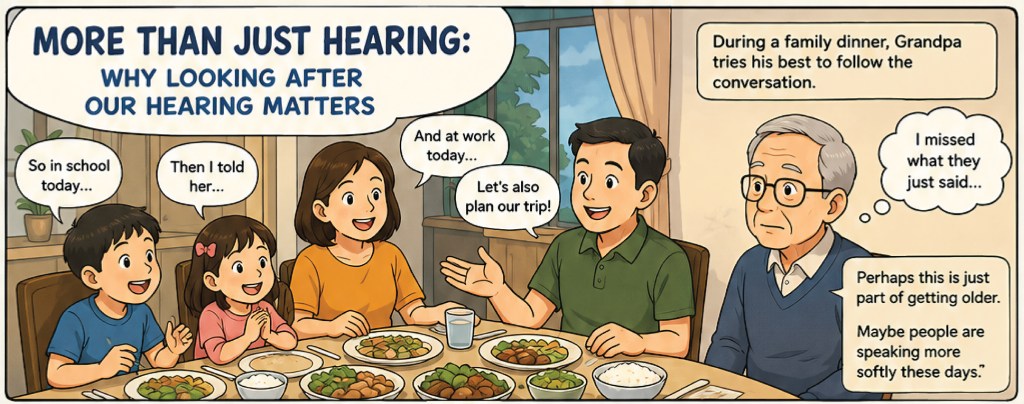
During a family dinner on an ordinary weekend, everyone is chatting happily around the table. The children are sharing stories, adults are discussing daily matters, and laughter fills the room.
Yet Grandpa seems a little quieter than usual.
When conversations move quickly, some words are missed. When several people speak at the same time, following the discussion becomes difficult. Occasionally, there is a gentle smile and a nod — perhaps because he does not want to interrupt the flow of the conversation.
Grandpa smiles and nods along, but sometimes he misses parts of the conversation. He may quietly tell himself:
“Perhaps this is just part of getting older.”
“Maybe people are speaking more softly these days.”
This is a common situation in many families.
Hearing loss often happens gradually. Unlike sudden illness, it may not feel like a problem at first. Many older adults continue with their daily activities and do not realise how much more challenging communication has become.
Hearing is not only about recognising sounds. It is about staying connected — to family conversations, shared laughter, and the voices of people we love.
Hearing Loss: A Growing Health Concern
Age-related hearing loss, or presbycusis, is one of the most common chronic conditions affecting older adults. It often develops gradually over many years, making it easy to overlook.
People may still hear sounds around them but find it increasingly difficult to understand speech, especially in noisy environments such as restaurants, family gatherings, or social events.
Because the change occurs gradually, many people adapt without realising how much hearing they have lost. When left unaddressed, hearing difficulties may affect much more than communication.
The Link Between Hearing Loss and Dementia
In recent years, researchers have recognised that hearing loss increases the risk of cognitive impairment, dementia, and Alzheimer’s disease. In fact, research suggests that the risk of dementia increases by approximately 16 percent for every 10-decibel worsening in hearing ability.
There has been one large-scale randomised trial, ACHIEVE, which investigated the effect of hearing intervention on reducing cognitive decline in older adults. Although no overall effect was observed in the total cohort, a substantial 48% reduction in cognitive decline was seen in a subgroup of participants who had higher baseline risk factors for cognitive decline and dementia.
This does not mean that everyone with hearing loss will develop dementia. Rather, it highlights the close link between hearing health and overall well-being. While more research is needed to determine whether treating hearing loss can reduce dementia risk, protecting hearing is increasingly recognised as an important part of healthy aging.
The Emotional Impact of Hearing Loss
The effects of hearing loss are often invisible. Yet its emotional impact can be profound.
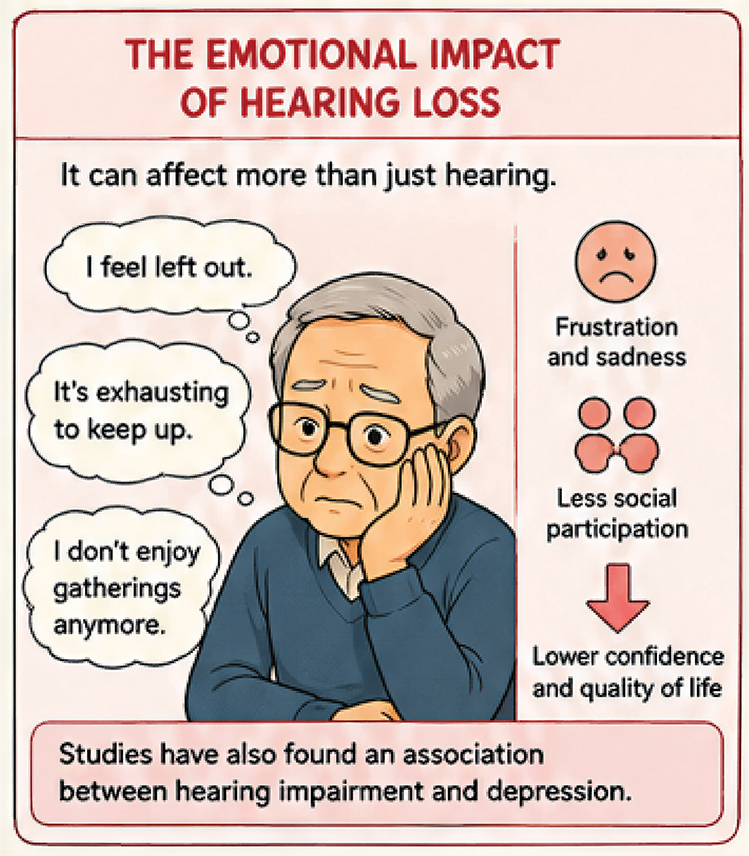
For some older adults, repeated difficulty following conversations can slowly lead to frustration and a feeling of being left out. Conversations that were once enjoyable may become exhausting. Family gatherings can feel overwhelming when multiple people speak at the same time.
Studies have also found an association between hearing impairment and depression.
Over time, hearing loss can affect confidence, independence, and overall quality of life. The issue is not simply that a person cannot hear. The deeper concern is that hearing loss may gradually reduce a person’s ability to participate fully in the relationships and activities that give life meaning.
Understanding Why Some People Hesitate to Use Hearing Aids
Despite the potential benefits of treatment, in many Asian societies, hearing aid use remains less common than expected. Some people worry that wearing a hearing aid will make them appear old, frail, or dependent. There is also the issue of cost.
In addition, some individuals have had disappointing experiences with hearing aids in the past. Earlier devices may have amplified unwanted background noise, felt uncomfortable, or required frequent adjustments. As a result, they concluded that hearing aids were not helpful.
Perhaps most importantly, many people are unaware that untreated hearing loss may affect emotional well-being, social engagement, and cognitive health — not just hearing itself.
Hearing Aids Are Not a Sign of Weakness
There is another way to think about hearing aids. We do not consider wearing spectacles a sign of weakness. Rather, we see them as a practical tool that helps people continue reading, driving, working, and enjoying life.
Hearing aids serve a similar purpose. Modern hearing aids are far more sophisticated than those available decades ago. They are smaller, more comfortable, and capable of adapting to different listening environments.
The goal is not merely to hear louder.
The goal is to remain connected — to conversations, relationships, and the world around us.
A Small Step Towards Healthy Aging
As our population ages, preserving hearing health deserves greater attention.
Aging is a natural part of life. While some changes are unavoidable, losing connection with the people we love does not have to be one of them.
Sometimes, a simple hearing assessment can be the first step toward hearing not just sounds — but the voices, laughter, and conversations that make life rich and meaningful.
1 Liang Z, Li A, Xu Y, Qian X, Gao X. Hearing loss and dementia: a meta-analysis of prospective cohort studies. Frontiers in Aging Neuroscience. 2021;13:695117. doi:10.3389/fnagi.2021.695117.
2 Yu RC, Proctor D, Soni J, et al. Adult-onset hearing loss and incident cognitive impairment and dementia – a systematic review and meta-analysis of cohort studies. Ageing Research Reviews. 2024;98:102346.
3 Lin FR, Pike JR, Albert MS, et al. Hearing intervention versus health education control to reduce cognitive decline in older adults with hearing loss in the USA (ACHIEVE): a multicentre, randomised controlled trial. The Lancet. 2023;402(10404):786–797. doi:10.1016/S0140-6736(23)01406-X.
4 Li CM, Zhang X, Hoffman HJ, Cotch MF, Themann CL, Wilson MR. Hearing impairment associated with depression in US adults, National Health and Nutrition Examination Survey 2005–2010. JAMA Otolaryngology–Head & Neck Surgery. 2014;140(4):293–302.
5 Ciorba A, Bianchini C, Pelucchi S, Pastore A. The impact of hearing loss on the quality of life of elderly adults. Clinical Interventions in Aging. 2012;7:159–163. doi:10.2147/CIA.S26059.

Dr. Sow Yih Liang
Consultant Ear, Nose, Throat, Head & Neck Surgeon
MBBS (UM), M. Med. (ORL-H&N) (UM), AM (Mal.)
Dr. Sow Yih Liang is a Consultant Ear, Nose and Throat (Otorhinolaryngology) Head and Neck Surgeon in LohGuanLye Specialists Centre. He enjoys sharing his medical knowledge with his fellow medical practitioners through organising or contributing as a speaker at workshops, symposiums or conference. Apart from engaging himself in numerous research and publication works, Dr. Sow is also actively involved in delivering oral and poster presentations. He was an adjunct lecturer for University Malaysia Sarawak (UNIMAS) from year 2016 to 2018. He also helped to train open system postgraduate students in Otorhinolaryngology, postgraduate students in Family Medicine Programme and medical student for elective attachment.


